
ISO 17025 Calibration Laboratory for Proximity Probes (Displacement, Vibration, and Oscillation Measurement)
Measuring shaft vibration displacement in rotating machinery is crucial, as these measurements provide insight into potential equipment faults. Consequently, the proximity loop—comprising the probe, extension cable, and transducer—must be properly calibrated. If the proximity system is uncalibrated and the maintenance team fails to address this, it could trigger an unintended trip of critical rotating equipment, halting the plant’s production line and imposing severe, irreversible economic consequences on the company.
Calibration of proximity systems involves the following two procedures:
Static Test (ISF/ASF)
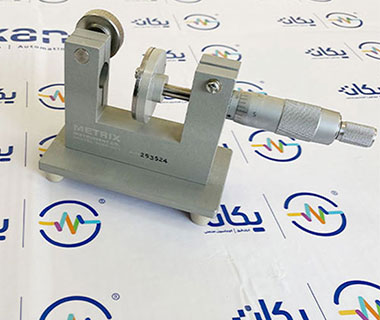
This test utilizes a spindle micrometer equipped with a target mounted on its spindle face. By moving the target back and forth—while remaining within the linear range of the proximity system—data regarding the gap-voltage relationship is collected, and the system’s sensitivity is subsequently evaluated.
The figure below shows a spindle micrometer from the brand Metrix, featuring a target made of 4140 steel.
Dynamic Testing
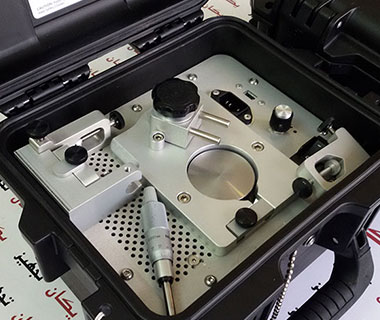
Dynamic testing consists of two components: Frequency Response and Amplitude Linearity (sensitivity testing). This test can be performed using a TK3 device or vibration shakers, as shown in the figure below.
How does a vibration proximity system work?
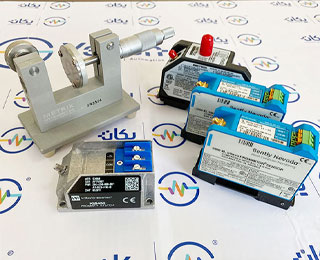
A non-contact vibration measurement system consists of three main components: the probe, the extension cable, and the oscillator. The operating mechanism is as follows: the oscillator—referred to in the industry by various other names such as transducer, driver, or “Proximitor”—generates a high-frequency signal, which creates a magnetic field at the tip of the probe. If this magnetic field is interrupted by a target (such as a shaft), eddy currents are induced within that target. As the distance between the probe tip and the target decreases, the magnetic field weakens; conversely, as the distance increases, the magnetic field strengthens. Consequently, the vibration displacement sensor calculates the level of vibration by measuring the distance between the probe tip and the target. The figures below display the oscillator, the probe, and the extension cable (from right to left).
Yekan’s calibration laboratory for vibration measurement equipment holds ISO/IEC 17025:2017 accreditation and is prepared to provide calibration services in full compliance with all requirements stipulated in the ISO/IEC 17025:2017 standard.

